Bowel problems in newborns – improving diagnosis of necrotising enterocolitis
Published on 9 May 2011
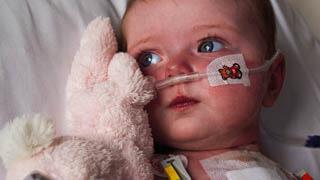
Each year in the UK, up to 3,000 babies develop a serious bowel problem called necrotising enterocolitis.1 Sadly, up to 35 per cent of these babies die and survivors often develop long-term health problems.1,2 The disease typically strikes without warning. By the time it is diagnosed, babies are often already extremely ill. Researchers are developing a new diagnostic test, which could allow babies with the disease to be identified and treated sooner. They hope this will reduce the likelihood of the disease progressing and therefore limit the devastating consequences.
Contents
- What's the problem and who does it affect?
- What is the project trying to achieve?
- What are the researchers' credentials?
- Who stands to benefit from this research and how?
- References
What's the problem and who does it affect?
A sudden, unpredictable and often lethal illness
Necrotising enterocolitis (NEC) is a devastating bowel disorder that mainly strikes premature babies. Around three per cent of newborns in neonatal units develop the disorder.2 Sadly, up to 35 per cent of these babies die.1,2 The numbers are even higher in babies who are born extremely early.2
What is the project trying to achieve?
An exciting discovery that could lead to earlier diagnosis
In earlier work, the researchers made an exciting discovery, which they believe could lead to a major breakthrough in the diagnosis of NEC. They found preliminary evidence that suggests the composition of a baby’s faeces changes in a characteristic way if he, or she, develops NEC. The researchers think that these changes begin early in the disease process, before the baby experiences any obvious symptoms. The researchers’ findings come from a small study involving 58 premature babies, 6 of whom developed NEC.
| Project Leader | Dr Andrew K Ewer MD MRCP FRCPCH |
|---|---|
| Project team | Professor Christopher SJ Probert MD FRCP FHEA Ms Rosemary Greenwood MSc Professor Norman M Ratcliffe PhD Dr Ben de Lacy Costello PhD |
| Location | Neonatal Unit, Birmingham Women's Hospital, University of Birmingham in conjunction with the School of Clinical Sciences, Bristol Royal Infirmary, the University Hospitals Bristol NHS Foundation Trust and the Faculty of Health and Life Sciences, Centre for Research in Analytical Material and Sensor Sciences, University of the West of England, Bristol |
| Other locations | School of Clinical Sciences, Bristol Royal Infirmary Department of Gasroenterology, Institute of Translational Medicine, University of Liverpool Faculty of Health and Life Sciences, Centre for Research in Analytical Material and Senser Sciences, University of the West of England, Bristol |
| Duration | 2.5 years |
| Grant awarded | 19 November 2010 |
| Start date | 23 November 2011 |
| End date | 22 March 2014 |
| Grant amount | £131,638.00 |
| Grant code | SP4588, GN1788 |
Highly experienced researchers from three universities – Birmingham, Bristol and the University of the West of England – are collaborating on this project.
Helping babies before they become seriously ill
The researchers aim to help premature babies who are at risk of developing NEC, a serious, often lethal bowel condition that tends to strike without warning.
1.Rees CM, Eaton S, Pierro A. Trends in infant mortality from necrotising enterocolitis in England and Wales and the USA. Arch Dis Child Fetal Neonatal Ed 2008; 93: F395-6.
4. Garner CE, Ewer AK, Elasouad K, Power F, Greenwood R, Ratcliffe NM, de Lacy Costello B, Probert CS. Analysis of faecal volatile organic compounds in preterm infants who develop necrotising enterocolitis: a pilot study. Journal of Pediatric Gastroenterology and Nutrition 2009;49:559-565.